The Science of Brain, Signal & Space
An interdisciplinary exploration of neuromodulation, electromagnetic biology, satellite technology, and brain-computer interfaces — grounded in peer-reviewed research and quantitative analysis.
Scientific Domains
Eight interconnected areas of research, each explored with real data, specifications, and peer-reviewed citations.
Technology Comparison
Comparing neuromodulation and BCI technologies across invasiveness, depth, precision, and field strength.
The Core Question
Could satellite technology ever be used for remote neuromodulation? This site examines that question through rigorous physics. The answer: the power density at ground level from even the most powerful communication satellites is approximately 17 orders of magnitude weaker than what's needed for the weakest known electromagnetic biological effect (the Frey auditory threshold).
This isn't a matter of engineering improvement — it's a fundamental constraint of physics, the inverse-square law, and the thermodynamics of energy transmission across hundreds of kilometers of atmosphere.
Discovery Timeline
60 years of breakthroughs — from Frey's microwave auditory effect to brain-spine interfaces.
Timeline of Key Discoveries
60 years of breakthroughs in neuromodulation, BCIs, and electromagnetic biology
Full Research Overview
Scroll through key findings from all domains — or click "Read full analysis" to explore each section in depth.
Neuromodulation Technologies
Four major techniques exist for modulating neural activity: TMS (magnetic pulses at 1–3 cm range), tDCS (weak DC current via scalp electrodes), DBS (implanted electrodes in deep brain nuclei), and Focused Ultrasound (acoustic waves through the skull).
All demonstrated techniques require either direct contact with the scalp or surgical implantation. TMS fields decay as 1/r³, making even centimeter-scale distance critical.
Read full analysis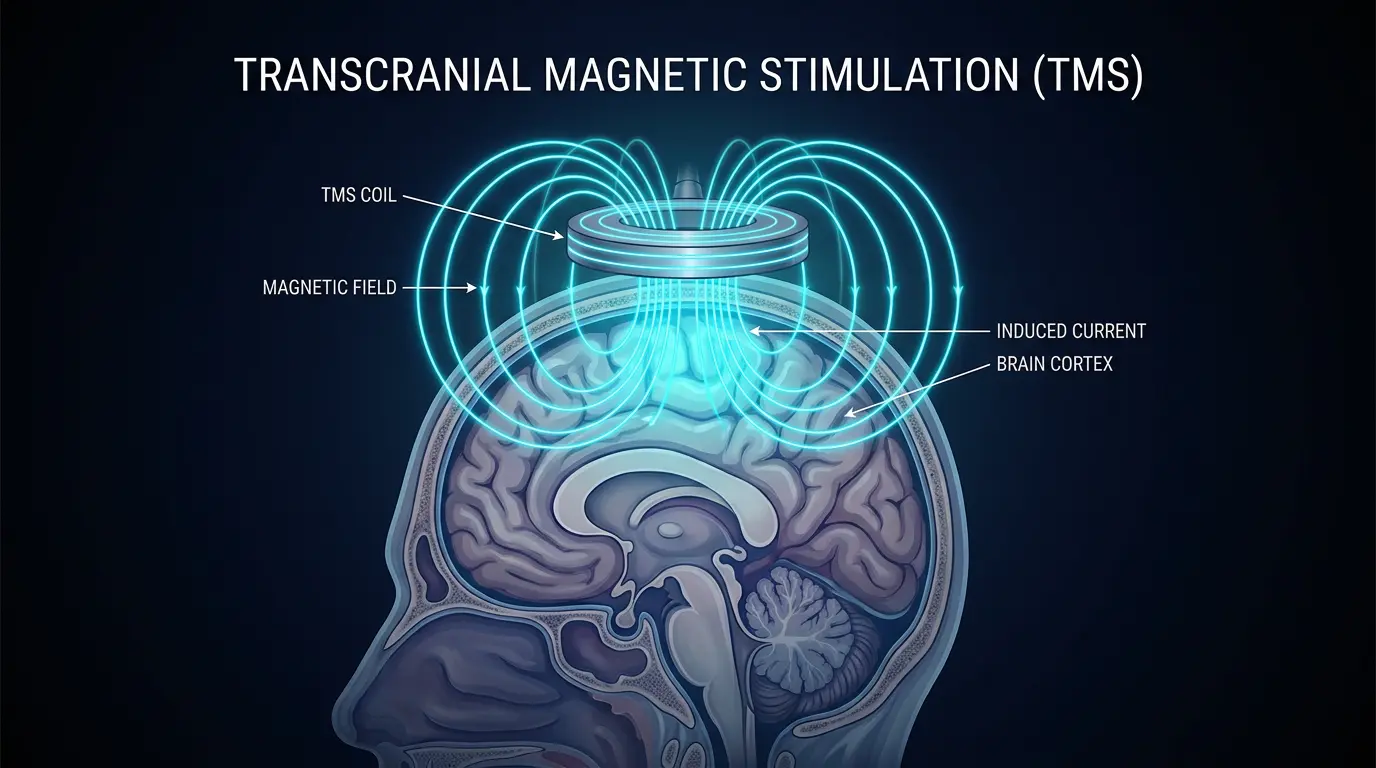
Electromagnetic Biology
The Frey effect (1962) remains the most dramatic proof: pulsed microwaves at 200 MHz–3 GHz induce perceived sounds without acoustic input. But it requires ~40 mW/cm² peak power density at close range.
SAR safety limits (ICNIRP: 2 W/kg for head exposure) define the boundary between thermal and potentially harmful absorption. Non-thermal effects remain scientifically contested.
Read full analysis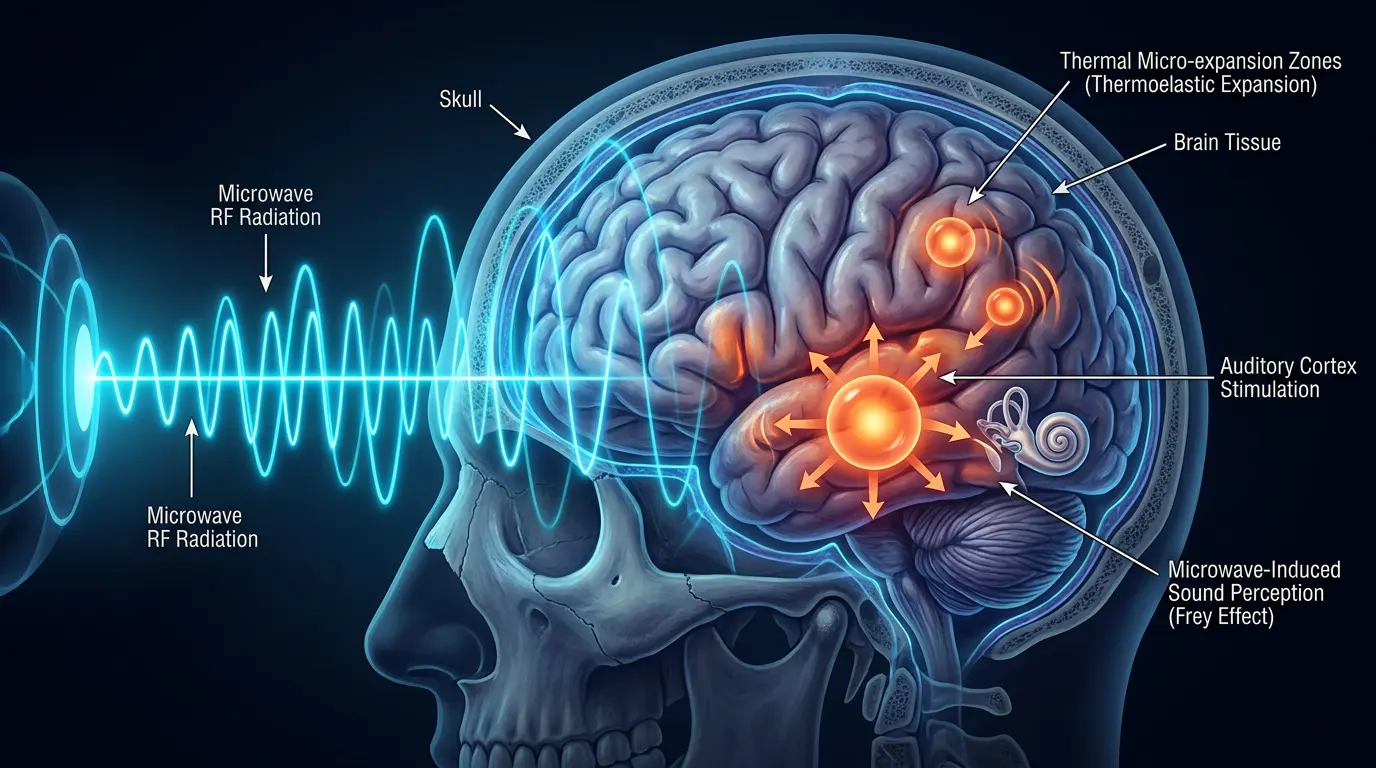
Satellite Technology
Starlink satellites operate at ~550 km with max EIRP of 66.89 dBW. At ground level, the power flux density is regulated to -146 W/m² per 4 kHz. Free-space path loss at Ku-band exceeds 170 dB — the signal arriving on the ground is weaker than cosmic background noise.
Read full analysisBrain-Computer Interfaces
From BrainGate's 96-channel Utah Array (2006) to Neuralink's 1,024-electrode N1 chip (2024), intracortical BCIs demonstrate that motor intent can be decoded from ~100–200 neurons with 95%+ accuracy for cursor control and 90+ chars/min typing speed.
Non-invasive EEG BCIs achieve only 10–25 bits/min — the skull attenuates signals by ~10,000×. Reading motor intent from orbit is physically impossible.
Read full analysis
Sensory & Cognitive Effects
TMS over V1/V2 induces phosphenes (visual flashes) and can suppress visual awareness within an 80–120 ms window. Memory consolidation can be disrupted by targeting the hippocampus during sleep with rTMS. Olfactory and gustatory modulation has been demonstrated via cortical stimulation — all at close range with direct tissue proximity.
Read full analysisControl of the Body
Since Barker's 1985 demonstration, TMS has shown that a single magnetic pulse can trigger involuntary muscle contractions via motor evoked potentials. FES restores hand grasp in tetraplegic patients. Courtine's epidural spinal stimulation restored walking in chronic paraplegia. Flesher's bidirectional BCI added touch to robotic prosthetics.
Every method requires electrodes or coils within 0–30 mm of target tissue.
Read full analysis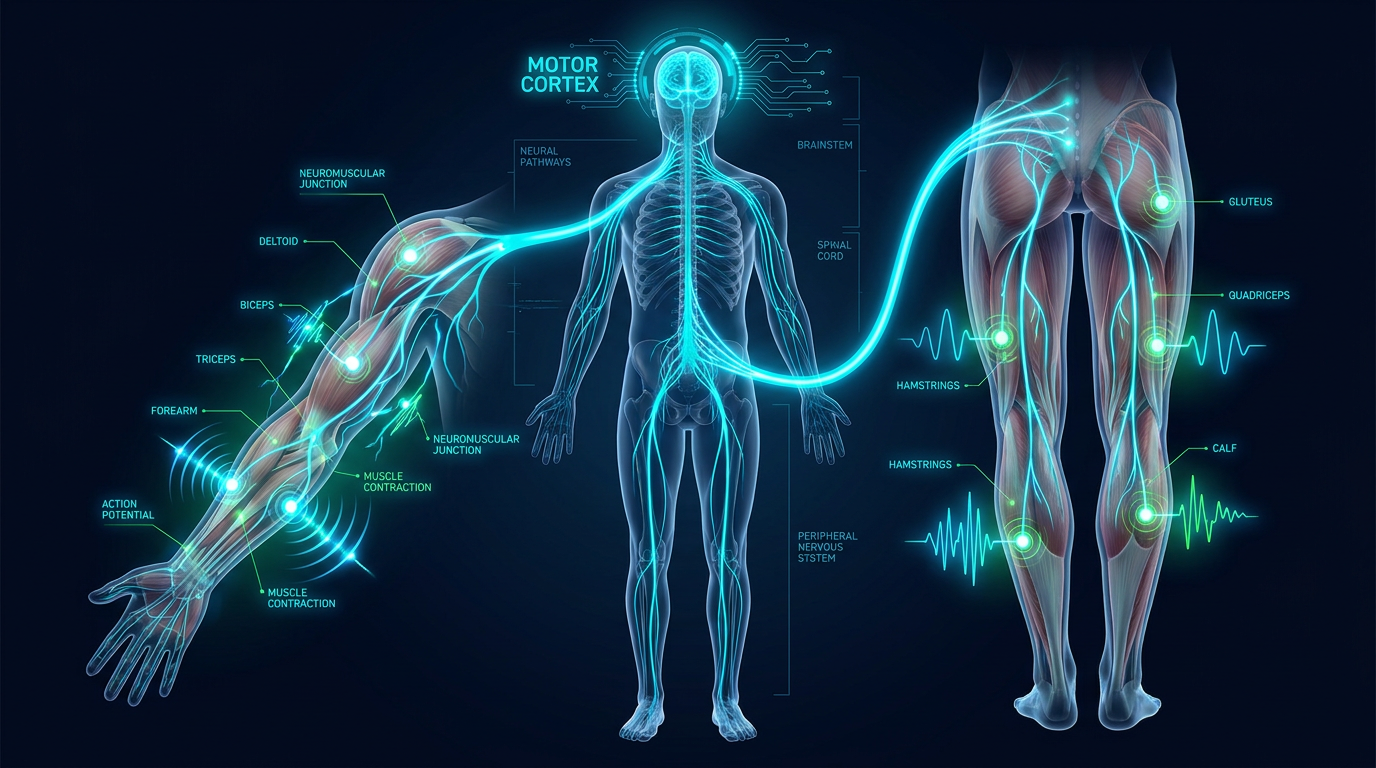
Satellite Architecture & Constellation
A hypothetical neuromodulation constellation would require 500,000+ satellites for continuous focused coverage. The link budget shows a 150+ dB gap between satellite power and biological thresholds. The required antenna aperture at 1 GHz would need to be 2,000+ km in diameter — larger than most countries.
Read full analysis
Feasibility Verdict
The power density gap between what satellites deliver at ground (~10⁻⁸ W/m²) and the weakest known biological EM effect (~400 W/m²) spans ~17 orders of magnitude. This is not an engineering challenge — it is a fundamental constraint of physics. The inverse-square law, atmospheric attenuation, diffraction limits, and thermodynamic barriers each independently make satellite-based neuromodulation impossible with any known or foreseeable technology.
Read full analysisInteractive Calculators
Explore the physics yourself — adjust parameters and see why the numbers make satellite neuromodulation impossible.
Interactive Link Budget Calculator
Adjust parameters to see the power gap in real time
The received power at ground is 134 dB below the biological effect threshold. That is a factor of 10^13 — absolutely impossible to bridge with any known technology.
Inverse-Square Law Simulator
Drag to see how power drops with distance
Starting from 1,000 W at 1 km reference distance (inverse-square law: P = P₀ / d²)
Constellation Sizing Calculator
Estimate satellites needed for a given coverage